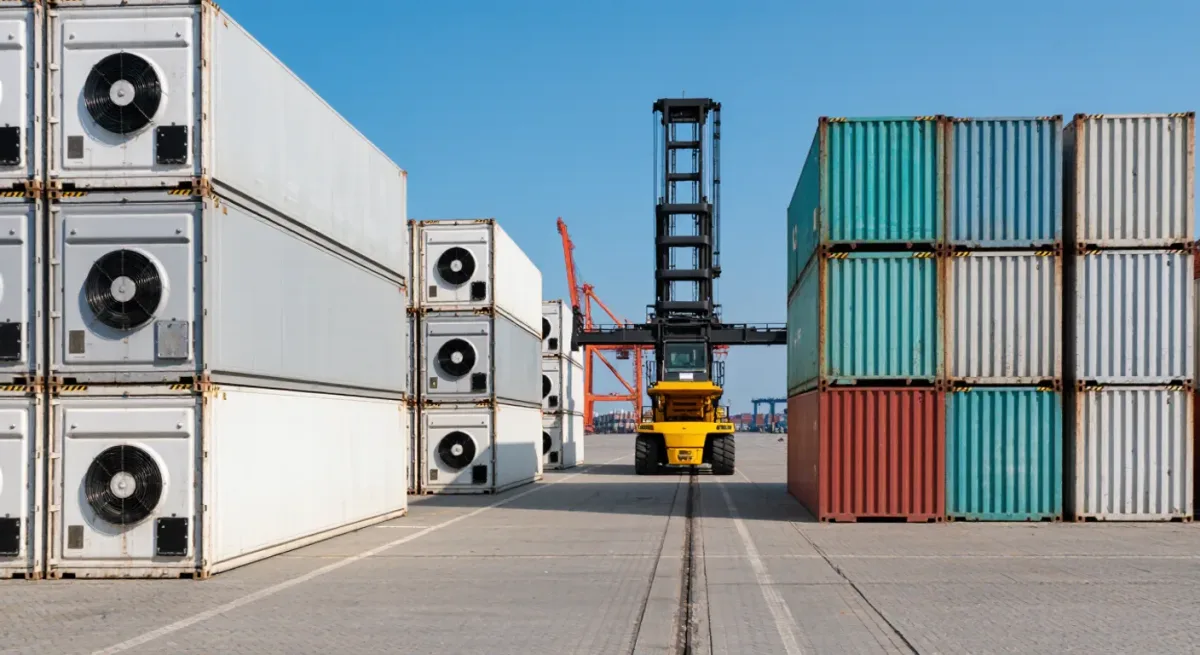
The Gulf Cooperation Council states import the large majority of their food, commonly estimated at 80 to 90 percent of requirements by the UN Food and Agriculture Organization and regional researchers. Water, not land, is the binding constraint: agriculture in the desert consumes what the aquifers do not have, so the six states have treated food as a logistics and finance problem rather than a farming one.
The strategy has three visible legs. Strategic stockpiles of rice, wheat and protein held in state silos and cold chains. Agricultural investment abroad, sovereign and corporate farmland from Sudan to Ukraine to Serbia, aimed at securing supply chains rather than owning calories outright. And a growing layer of controlled-environment production at home, the greenhouse and vertical-farm sector that puts local tomatoes on Gulf supermarket shelves year-round.
The stockpile layer
Gulf states expanded reserves after the 2007-08 food price crisis, when export bans in producer countries briefly threatened supply. Saudi Arabia's state grain organisation holds months of wheat cover, and the UAE's food security strategy targets a stated goal of ranking at the top of the Global Food Security Index by 2051, a target published with the strategy's launch in 2018. COVID-19 stress-tested the model in 2020 and the chains held.
Farms abroad
Gulf capital farms land it cannot farm at home. Saudi and UAE agribusinesses hold operations across the Black Sea region, East Africa and the Balkans; Saudi Arabia's state agricultural investor SALIC built positions including a large Ukrainian farming group, and Abu Dhabi's Al Dahra runs farming and supply operations across several countries. The intent is supply-chain control, contractable tonnage moving through Gulf-owned logistics, rather than food sovereignty in the literal sense, and the war in Ukraine since 2022 tested exactly that logic.
| Pillar | Examples | What it buys |
|---|---|---|
| Strategic stockpiles | State silos, cold chains | Months of buffer against export bans |
| Overseas farming | SALIC, Al Dahra operations abroad | Contracted supply and logistics control |
| Home agtech | Greenhouses, vertical farms | Fresh produce, import substitution at the margin |
The greenhouse bet
Home production is the newest leg. UAE-controlled-environment pioneers such as Pure Harvest Smart Farms, founded in 2018, demonstrated that premium tomatoes and greens can be grown economically in the desert with the right greenhouse technology, and the sector has attracted hundreds of millions of dollars in capital. Output remains a small share of consumption, but it has shifted the fresh-produce mix, shortened supply lines for premium categories, and seeded an agtech services industry with regional ambitions.
The economics stay honest: Gulf greenhouses win on freshness and water efficiency, not on commodity price. Staple calories, wheat, rice, oils, will remain imported for the foreseeable future.
Why shipping matters more than farming
Because imports dominate, the real security asset is the corridor. Gulf ports, container lines and re-export hubs mean the GCC buys flexibility: when one source closes, cargoes reroute. The 2024-26 Red Sea shipping disruption raised freight costs and lengthened routes, and Gulf importers rerouted without consumer-level shortage, which is the system working as designed.
For how the wider import economy underpins daily budgets, see our guide to the cost of living in Dubai, where imported food pricing feeds directly into household inflation.
The wheat and rice supply line, concretely
Follow the region's most important staples and the system becomes concrete. Gulf wheat comes overwhelmingly from the Black Sea, and the grain corridor, the Suez route and Gulf ports form the artery; every disruption of that artery, war in Ukraine, shipping attacks in the Red Sea, has forced the rerouting and repricing the 2020s rehearsed. Rice arrives from India, Pakistan and Thailand on Asia-Gulf lines that have proven more stable but concentrate origin risk in a single dominant supplier for several Gulf states. Sugar, poultry and edible oils repeat the pattern with different geographies. The Gulf's response, buffer stocks counted in months of consumption, contracted tonnage through owned or affiliated traders, and origin diversification, is visible in every state grains organisation's procurement programme, and the system's quiet success is that no Gulf state experienced consumer-level shortage through the decade's disruptions.
| Staple | Dominant origins | Exposure |
|---|---|---|
| Wheat | Black Sea | War and corridor risk |
| Rice | India, Pakistan, Thailand | Export-policy concentration |
| Poultry | Brazil, regional production | Freight and disease cycles |
| Edible oils | Malaysia, Indonesia, Ukraine | Price volatility |
Water: the constraint under everything
The 2026 regional conflict supplied the decade's sternest test, with Red Sea rerouting lengthening sailings and raising freight, and the system's grade is written in the region's supermarkets: full shelves, modest price blips, no rationing. That outcome was engineered, not fortunate, and it is the standard against which the next disruption will be measured.
Food security in the Gulf is finally water security. Agriculture consumes the region's scarcest input, and the twentieth century's subsidised groundwater farming, Saudi wheat most famously, ended when aquifers did, replaced by imports and desalination-fed urban supply. The implication runs one direction: domestic production will expand only where it uses water efficiently, greenhouses, vertical farms and precision irrigation, and the staples will stay imported. Every serious food-security strategy in the six states now says this explicitly, which is why the honest centre of the policy is logistics and reserves, with agtech as the innovation layer rather than the answer.
The summary
The Gulf does not grow its dinner; it owns the chain that delivers it. Reserves, foreign farms and desert greenhouses each cover a different failure mode, and the 2020s have stress-tested all three. The system's honest weakness is concentration: a region importing most of its calories is hostage to sea lanes, and every strategy document in the six capitals says so quietly.