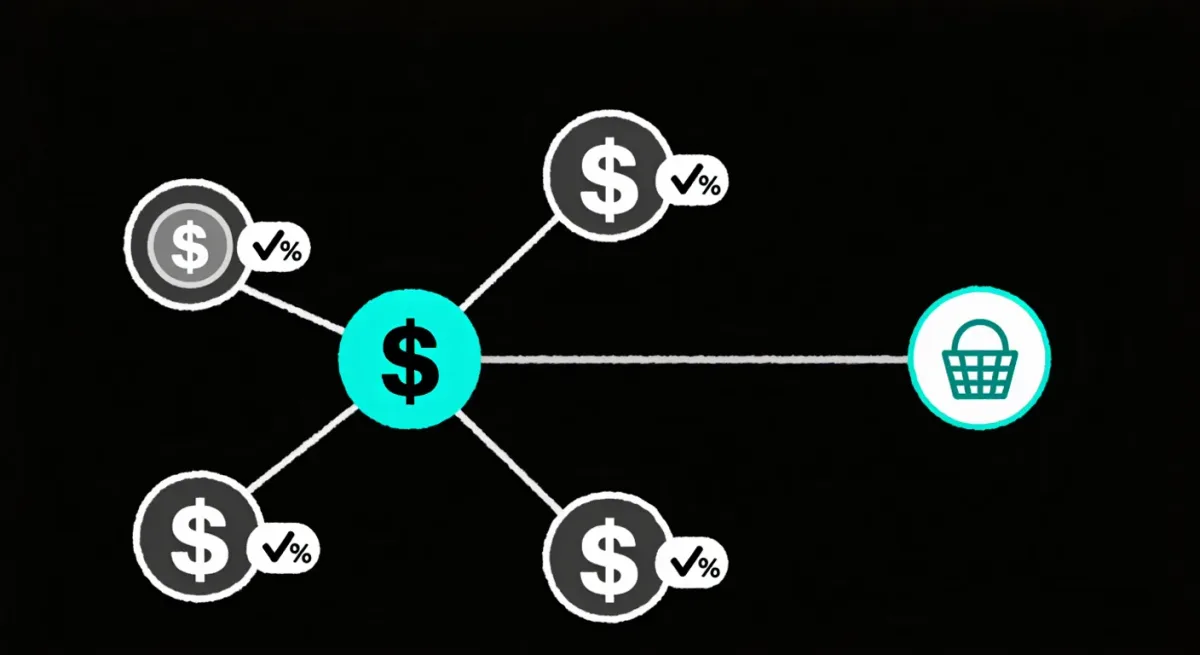
Most Gulf currencies are fixed against the US dollar: the UAE dirham at 3.6725, the Saudi riyal at 3.75 since 1986, the Qatari riyal at 3.64 and the Bahraini dinar at 0.376, with the Omani rial at 0.3845 dollars. Kuwait is the exception, pegging to an undisclosed currency basket since 2007. The anchors have held through five decades of oil cycles because oil is priced in dollars, and the pegs convert that dollar revenue into stable domestic prices.
The consequence that matters most for business is interest rates. To hold a fixed exchange rate, Gulf central banks must keep local rates in step with US rates, so Federal Reserve decisions pass directly into Gulf financial conditions. When the Fed hiked through 2022-23, Saudi and UAE mortgage and deposit rates rose in near lockstep, unbidden by any local decision.
How the peg actually holds
A fixed rate is a standing promise to buy and sell dollars at the quoted price. Central banks hold foreign reserves and sovereign assets far exceeding the money supply, and they lean on banks' foreign-currency positions with reserve requirements. Speculative attacks, attempted most famously against the riyal in the late 1990s and tested again during the 2014-16 oil slump, failed against reserves measured in the hundreds of billions and an unusual willingness to let domestic rates rise to defend the fix.
| Currency | Rate per dollar | In force since |
|---|---|---|
| UAE dirham | 3.6725 | Repegged at this level in the late 1990s |
| Saudi riyal | 3.75 | 1986 |
| Qatari riyal | 3.64 | 2001 |
| Bahraini dinar | 0.376 | 2001 |
| Omani rial | 0.3845 | 1986 |
| Kuwaiti dinar | Managed basket | 2007 |
What the peg buys
Three things. Price stability for import-dependent economies: with the overwhelming majority of consumer goods imported, a stable dollar rate keeps import prices predictable. Investment simplicity: dollar-based investors need no currency hedge in Gulf assets, which lowers the cost of capital. And fiscal discipline of a sort: a peg forbids financing budgets by printing money, forcing adjustment through spending and reserves.
What it costs
Monetary independence, entirely. Gulf central banks cannot cut rates when oil slumps if the Fed is hiking, which is exactly the 2022-23 experience: economies slowing with crude still received imported tightening. The peg also transmits imported inflation when the dollar weakens against Asian and European currencies, as in the mid-2000s, when Gulf inflation ran hot despite local policy restraint.
Devaluation talk returns in every oil downturn, and the honest answer each time is the same: the political and economic stake in the dollar link exceeds the accounting cost of holding it, and reserves make the defence credible. The 2014-16 episode, with oil near $30, ended with every peg intact and Saudi Arabia choosing fiscal austerity over the exchange rate.
What it means for investors and residents
For investors, Gulf bonds, deposits and equities are effectively dollar assets with local rules; the peg is why regional rate cycles rhyme with the Fed's. For residents, a dollar-linked salary is stable against the world's reserve currency but fluctuates against the euro and yen with the dollar index. For corporates, hedging budgets against non-dollar currencies, not the local one, is the recurring treasury task.
The interest-rate transmission that comes with the peg is one reason Gulf mortgage and deposit pricing moves as it does, a mechanism covered concretely in our explainer on Islamic banking in the Gulf, where profit rates track the same imported cycle.
For the region's borrowers the peg cuts the other way: Gulf dollar bonds carry no currency risk against the currencies that price them, which is why the region's sovereigns and corporates borrow internationally at spreads tighter than their ratings alone would suggest. The peg is, among other things, a standing credit enhancement, and every finance ministry in the Gulf prices it as such.
A short peg history
The Gulf's currency arrangements date from the sterling era and migrated with global finance. Gulf currencies were historically tied to sterling, and when the pound floated in 1967-71, the region's oil contracts had already moved to dollars, making the dollar the natural anchor. The riyal and the rial fixed at their current levels in 1986, amid post-oil-boom austerity; Qatar and Bahrain fixed in 2001 as Gulf monetary union talks advanced; the UAE held its 3.6725 level through the crises that followed. The Gulf Cooperation Council's own single-currency project, agreed in principle decades ago, stalled after Oman withdrew and the UAE declined to join the launch group, leaving the pegs as the region's standing monetary constitution and Kuwait's basket as the sole dissent.
What would break a peg, hypothetically
Two scenarios recur in analysts' stress cases, and neither is current. The first is a fiscal rupture, a government unable to finance itself and tempted to print, which the pegs' reserve backing forecloses in every Gulf state today. The second is a divergence shock, a US policy cycle violently wrong for oil exporters, which occurred in mild form in 2022-23 and was absorbed through fiscal policy instead. The historical record is instructive: Gulf authorities have repeatedly chosen domestic austerity over devaluation, most visibly in 2014-16, because the credibility of the peg is priced into every dirham and riyal of regional borrowing. Investors who hedge nothing against the peg are expressing a view the region's own finance ministries have spent forty years supporting.
The one-line version
Gulf currencies are pegged because oil is sold in dollars, the pegs are defended by reserves that dwarf speculation, and the price of that stability is a monetary policy made in Washington.