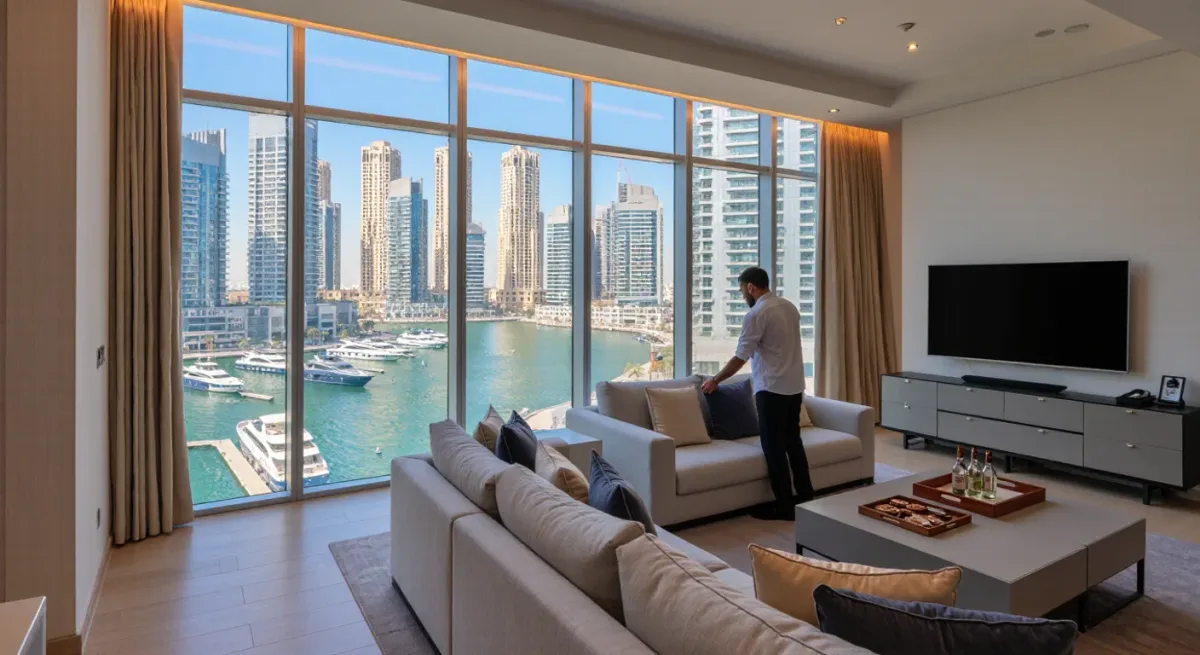
A well-located one-bedroom Dubai holiday home can plausibly gross AED 90,000 to 140,000 a year at typical achieved nightly rates and occupancy, before fees and costs, based on the market's licensing data and published rate ranges. The sector's size is verifiable: Dubai's Department of Economy and Tourism counted 21,132 licensed holiday homes with 32,794 rooms as of May 2023, up 45.5 percent year on year, and industry counts have since pointed toward roughly double that level by 2025-26.
Short-term rental is regulated, not informal. Every unit listed for short lets must be registered with DET before advertising, a rule that has applied since Dubai's short-stay sector was first licensed in 2013. Operators without permits face fines, and platforms delist unregistered units.
The permit system
Individual owners can license up to eight units in their own name. Beyond that, a professional operator licence is required, which is why management companies dominate the larger buildings. Permits are per unit, issued annually, and tied to the title deed or landlord no-objection where a long-term tenant sublets.
Two charges attach to every licensed night: the tourism dirham, a per-bedroom nightly fee set by emirate regulation, and a municipality charge on the listed rate. Both are remitted through the licensing system, and both belong in any revenue model before comparing a holiday home against a long-term let.
Rate bands and occupancy
| Unit type | Typical nightly rate band |
|---|---|
| Studio, older districts | AED 250-400 |
| One-bedroom, Marina/JBR/Downtown | AED 450-800 |
| Two-bedroom, prime towers | AED 800-1,400 |
| Villa, Palm Jumeirah | AED 1,500 and above |
Rates are listing-derived and seasonal. The Dubai market peaks from October to April, tracks event calendars such as the shopping festival window, and softens in the summer months, when operators discount aggressively to hold occupancy. Annualised occupancy for professionally managed units commonly lands in the 70-85 percent range in normal years, according to operator disclosures.
Costs against the gross
The deduction stack is what separates a good asset from a marketing brochure. Management fees run from 15 to 25 percent of revenue depending on service level. Cleaning and consumables scale with turnover. Service charges on the building are paid regardless of occupancy, and on short-let towers they are frequently high per square foot because amenities are hotel-grade. Add the tourism dirham, municipality charge, licence renewals and utility load, and net yields of 5 to 8 percent on purchase price are the realistic band quoted by operators for well-run units.
Holiday home or long-term let
The comparison is now structural. Long-term rents in Dubai have risen faster than nightly rates since 2022, narrowing the premium that short lets once commanded. The holiday-home case rests on flexibility and peak-season capture; the long-term case rests on lower costs and predictable income. Buildings matter more than districts: a tower saturated with short-let stock competes against itself, while buildings that restrict permits protect nightly rates for the units inside.
Investors who want exposure to income-producing real estate without operating a unit have a listed alternative in the region's REIT market, covered in our explainer on how Gulf REITs work.
Seasonality and the event calendar
Dubai's short-let revenue is not spread evenly across the year, and an annual projection built on peak-season nightly rates will overstate returns badly. The high season runs October to April, anchored by weather, the shopping festival window in January and February, and the events calendar that fills hotels and apartments around major conferences and exhibitions. Shoulder months trade at moderate rates with healthy occupancy. Summer, July and August above all, is the discount season, when operators cut rates steeply to keep units turning and families travel home, and a professionally managed projection will show single-month revenue falling to half or less of a February peak.
Event demand deserves its own line in the model. Conference weeks, championship sport and festival periods produce short, sharp spikes in both rates and occupancy, and units with flexible cancellation policies capture more of them than units locked into longer bookings. The reverse also holds: a unit committed to a discounted month-long summer booking is unavailable for the September rebound, which is why better operators manage calendar mix rather than chasing pure occupancy.
Self-management versus operators
Owners choose between running the unit themselves and contracting an operator, and the economics differ less than the marketing suggests. Self-management saves the 15 to 25 percent management fee and suits owners who live nearby, handle their own cleaning arrangements and can respond to guests; it costs time, and one mishandled dispute can cost more than a year of fees. Operators bring pricing software, housekeeping crews and permit administration, and their scale wins better platform placement. The honest comparison is net income per hour of owner effort, and for most overseas buyers, the operator route is not a convenience choice but the only workable one.
Between the two sits the guaranteed-income offer, an operator committing to a fixed payment regardless of performance. These transfer occupancy risk to the operator and price that transfer into the guarantee, which typically sits below realistic net income in strong years and above it in weak ones. Reading the guarantee against the market's seasonal shape, and checking the operator's permit compliance record, is the whole of the due diligence.
What to check before buying for short-let
- Whether the building's declaration permits short-term use and whether a quota applies.
- Service charges per square foot, benchmarked against competing towers.
- District cooling contracts, which pass through to running costs in most new towers.
- Operator terms: management fee, minimum guaranteed income if offered, and exit rights.
- Permit lead times and the DET delisting risk for non-compliant units.
The headline answer stands: double-digit gross figures are achievable in peak season and often quoted, but the licensed market's own data on rates, fees and occupancy supports mid-single-digit net yields as the honest base case.