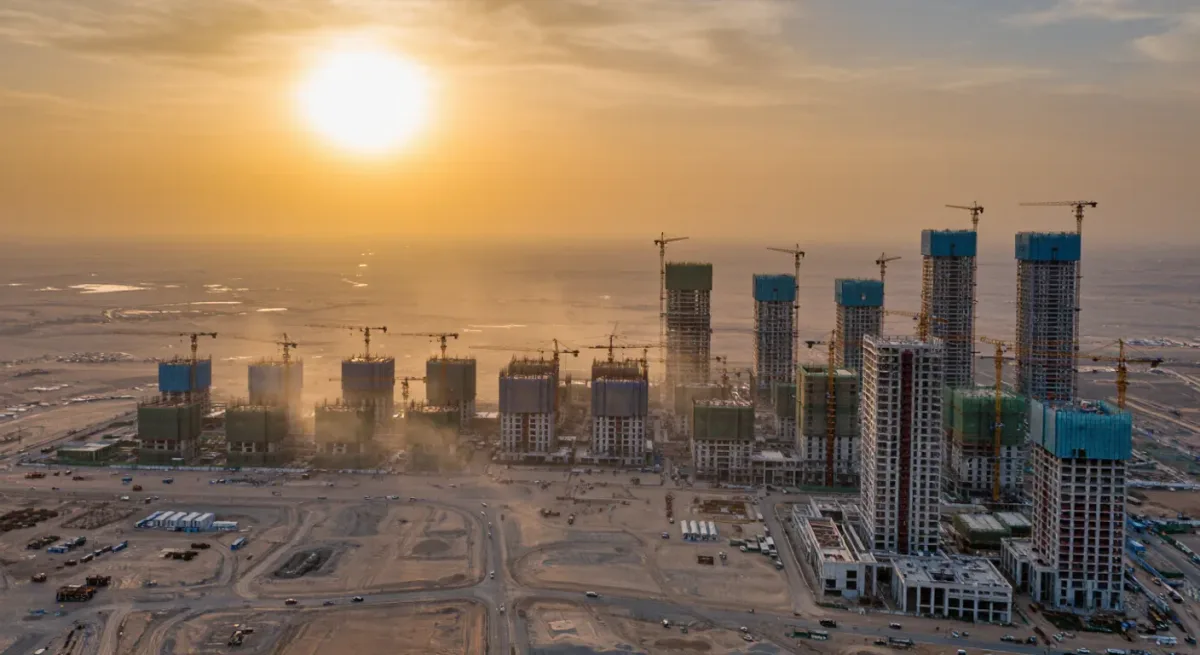
Egypt's New Administrative Capital is a state-led city of roughly 700 square kilometres under construction east of Cairo since 2016, designed for a target population in the millions and already housing the government: ministries and the cabinet relocated to the new district through 2021-2023. Its developer, the Administrative Capital for Urban Development company (ACUD), is majority-owned by the Egyptian state with military-affiliated and New Urban Communities Authority stakes.
The commercial centrepiece is the Central Business District: about twenty towers contracted to China State Construction Engineering Corporation, including the 385-metre Iconic Tower, built as one of the largest Chinese civil contracts in Africa. For buyers and investors, the project has become Egypt's property market's defining bet: a whole CBD priced in hard currency, aimed at diaspora and Gulf capital as much as at Cairo.
What has actually been delivered
More than sceptics expected, less than renderings imply. The government district functions: civil servants work on a compressed week from the new ministries, and parliament has met in the city. The CBD towers have topped out and are fitting out in phases. The monorail and electric train links to Cairo have been under construction for years, with sections opening progressively. Residential districts pitched at middle-income buyers through ACUD's own sales programmes have handed over units in batches.
| Component | Status as commonly reported |
|---|---|
| Government district | Operating; ministries relocated 2021-2023 |
| CBD towers and Iconic Tower | Topped out; phased fit-out and handover |
| Residential neighbourhoods | Batches handed over; occupancy thin in places |
| Transport links | Monorail and rail lines opening in stages |
The money model
ACUD sells land and units to fund construction, and hard-currency sales to expatriate Egyptians and Gulf buyers became central after Egypt's currency crises squeezed domestic purchasing power. Developers holding land inside the city, including listed Egyptian houses and Gulf-backed ventures, market apartments with dollar-linked instalment plans. Egypt's broader agreement context, including the large Emirati investment commitment to Ras El Hekma announced in 2024, has repeatedly been cited by officials as the kind of external funding that keeps megaproject pipelines liquid.
The risk has two names: absorption and liquidity. Occupancy in delivered districts remains patchy, with schools, clinics and retail clustering around the populated phases rather than spreading evenly. Secondary-market transactions are thin, and resale prices for early buyers have depended heavily on the phase of delivery rather than on comparable market depth.
Who buys, and why
Three groups dominate. First, diaspora Egyptians buying instalment-plan units as inflation hedges, the steadiest demand pool. Second, Gulf investors, both institutional land buyers and individuals, for whom the currency-adjusted entry prices and currency-linked contracts read as protection. Third, government-adjacent households relocating because their jobs moved, a captive but narrow base.
For comparison with Gulf freehold regimes that compete for the same capital, our explainer on Abu Dhabi's freehold investment zones sets out how an open-ownership market is structured.
Living and working in the new capital today
The city's operating reality has settled into a rhythm its planners did not fully script. Government employees work a compressed week from the new ministries, four long days, and commute on schedules that turned the new rail and bus links into peak-load infrastructure two days a week rather than five. The CBD's early office occupiers are dominated by banks and state enterprises taking space in towers whose handovers lag the district's marketing. Residential occupancy clusters tightly around the phases with functioning schools and clinics, leaving other districts quiet in the evenings, a pattern residents describe as a city that is full on paper and partial at street level.
Retail and hospitality have followed population rather than leading it. District centres with grocery anchors, pharmacies and cafés operate profitably; destination retail waits for weekend traffic that full occupancy will eventually supply. For investors, the observable lesson from the delivered phases is that services, not towers, determine which districts feel alive, and the secondary market has begun pricing that difference: units in serviced, occupied phases trade at premiums to identical units in early districts waiting for their schools.
The commute economics
The new capital's success ultimately rides on connections to Cairo, where the majority of the population and much of the talent remain. The monorail and electric train links are the physical answer, and their staged openings set the timetable for the city's absorption: every completed section converts a district from an island into a suburb, with measurable effects on rental demand. Developers and brokers price proximity to confirmed stations, and buyers should distinguish funded, under-construction links from announced alignments, a distinction marketing material blurs. The honest metric for the project's next five years is not units delivered but average commute time from the populated phases to central Cairo, a number that falls as each transport section opens and that no press release can improve on its own.
What to watch
- Transport milestones: monorail sections and rail links determine whether the city works as a Cairo commuter district or stands alone.
- Occupancy data on delivered phases, which ACUD and district developers disclose unevenly.
- Currency policy, since instalment contracts are typically indexed to hard currency and devaluation shifts affordability.
- Gulf state investment tranches, which anchor confidence in later phases.
The New Administrative Capital is no longer a rendering; it is a functioning government district surrounded by a bet on finance, diaspora savings and transport. Whether that bet compounds or stalls is, year by year, the single most-watched question in Egyptian real estate.