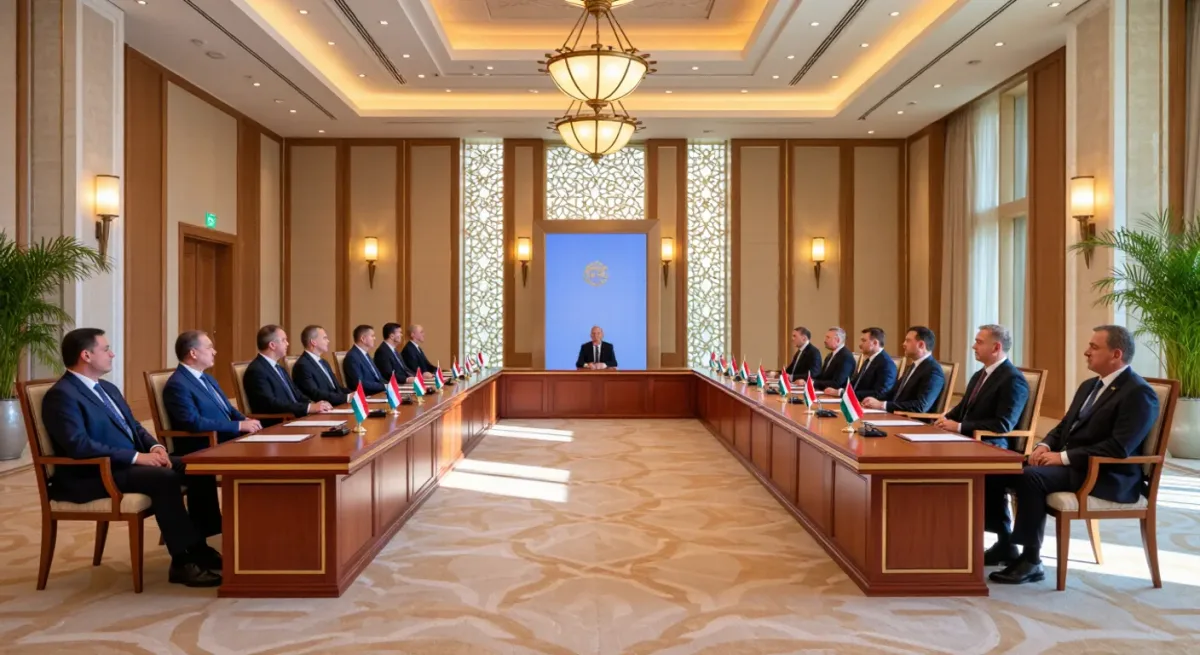
Abu Dhabi's G42 has signed a $1 billion agreement to develop sovereign AI and data infrastructure across Vietnam, working with local partners to build the country's national AI capability, The National reported on February 9, 2026. The deal is the UAE company's largest committed programme in Southeast Asia and one of the biggest sovereign-AI contracts signed by any Gulf firm abroad.
Sovereign AI, a country owning and controlling the compute, models and data that run its public services and economy, has become the Gulf technology sector's leading export category, and this agreement extends it to a market of 100 million people. For Gulf AI diplomacy, the Vietnam deal marks the moment the model went fully export-scale.
What the agreement covers
According to the announcement, the programme spans AI infrastructure, data centres and capability-building with Vietnamese partners, following the template Gulf operators have refined at home: a national compute platform, local-language models, and state-aligned governance. G42's infrastructure arm Core42 has delivered similar sovereign stacks in the UAE, from government cloud to Arabic language models, and the Vietnamese programme draws on that playbook.
| Component | What it means |
|---|---|
| National compute | GPU capacity inside Vietnam serving government and enterprise |
| Data infrastructure | Data centres and sovereign cloud services |
| Local capability | Training and partnerships with Vietnamese institutions |
| Governance | State-aligned data residency and model policy |
Why Vietnam wants it, and why G42 does
Vietnam's interest is straightforward: it has a fast-growing digital economy, a manufacturing base upgrading toward electronics and AI hardware, and a government policy of building domestic AI capacity rather than renting it from US platforms. A sovereign stack delivered by a non-American, non-Chinese operator fits Hanoi's hedging instincts.
G42's interest is portfolio logic. The Abu Dhabi group, whose background and structure are covered in our explainer on what G42 is, has positioned itself as the neutral sovereign-AI partner for countries that want frontier capability without dependence on a single bloc, and its earlier regional engagements in Asia and Africa now scale to a $1 billion commitment.
The competitive context
The deal lands in an intensifying race. US hyperscalers are building sovereign regions across Asia; China's vendors offer state-backed alternatives; and Gulf operators, funded by sovereign capital and partnered with US chipmakers, sell a third path. G42's 2024 investment partnership with Microsoft, worth $1.5 billion, anchored its Western technology relationships, and the group has simultaneously marketed itself across the global south as infrastructure provider rather than platform power.
For Vietnam, multiple suitors mean leverage; for the Gulf, each signed programme extends the region's claim to be the neutral broker of AI infrastructure, a role with both commercial and strategic returns.
The Vietnam corridor's wider Gulf context
The agreement also continues a Gulf-Vietnam economic courtship with its own momentum. The UAE has pursued a trade agreement with Vietnam among its wider network of partnerships, Gulf funds have taken positions in Vietnamese consumer and industrial assets, and energy cooperation, from LNG supply to renewables, has featured in successive high-level visits. Vietnam, for its part, courts Gulf capital as it climbs the manufacturing value chain, and AI infrastructure is the newest expression of a relationship previously expressed in trade and energy. The February 2026 signature should be read against that ledger: the AI deal is the largest single item, but the corridor around it, trade, energy and investment, is what makes the item durable.
Sovereign AI as a Gulf export industry
The Vietnam deal sits inside a pattern that deserves a name, because it is becoming an industry. Gulf operators, G42 foremost, now sell national AI stacks the way Western firms sell cloud: compute procured and hosted in-country, models tuned to local language and law, government platforms built atop them, and financing arranged through state-backed capital. The customers are mid-size powers that want frontier capability without dependency on a single bloc, Southeast Asia's fast growers, Central Asian states, African economies digitising from a low base, and the Gulf's pitch to them is credibility: buyers can see the sellers built the same stack for themselves, at home, at scale.
| Component | What the buyer gets |
|---|---|
| National compute | GPU capacity owned and hosted domestically |
| Local models | Tuned to language, regulation and data law |
| Government platform | Services, identity and data exchange layers |
| Financing | State-backed capital and vendor terms |
The industry's economics are unproven, and honesty requires saying so: sovereign AI contracts are capital-heavy, slow to build, and priced partly in geopolitical goodwill rather than cash yield, and no Gulf operator has yet published the unit economics of a completed national deployment. What the Vietnam agreement demonstrates is demand, a hundred-million-person market choosing the Gulf stack, and demand at that scale is how export industries start. The region spent the 2010s exporting capital; the 2026 pattern, AI infrastructure sold abroad the way petrochemicals and ports expertise already are, is the beginnings of a second export economy, and February's signature is its largest exhibit to date.
What to watch next
- Confirmed project entities and site announcements in Vietnam over the coming quarters.
- Hardware sourcing: whose GPUs anchor the compute, and under what export-control conditions.
- Follow-on deals in comparable markets, the clearest test of whether this is a template or a one-off.
- Gulf state-level visits and financing agreements that typically accompany such programmes.
The February 9 agreement, at $1 billion and a national scale, is the largest single proof point yet that sovereign AI has become a Gulf export industry. The follow-through, megawatts delivered in Vietnam rather than paper signed in Abu Dhabi, will decide whether the category earns its valuation.