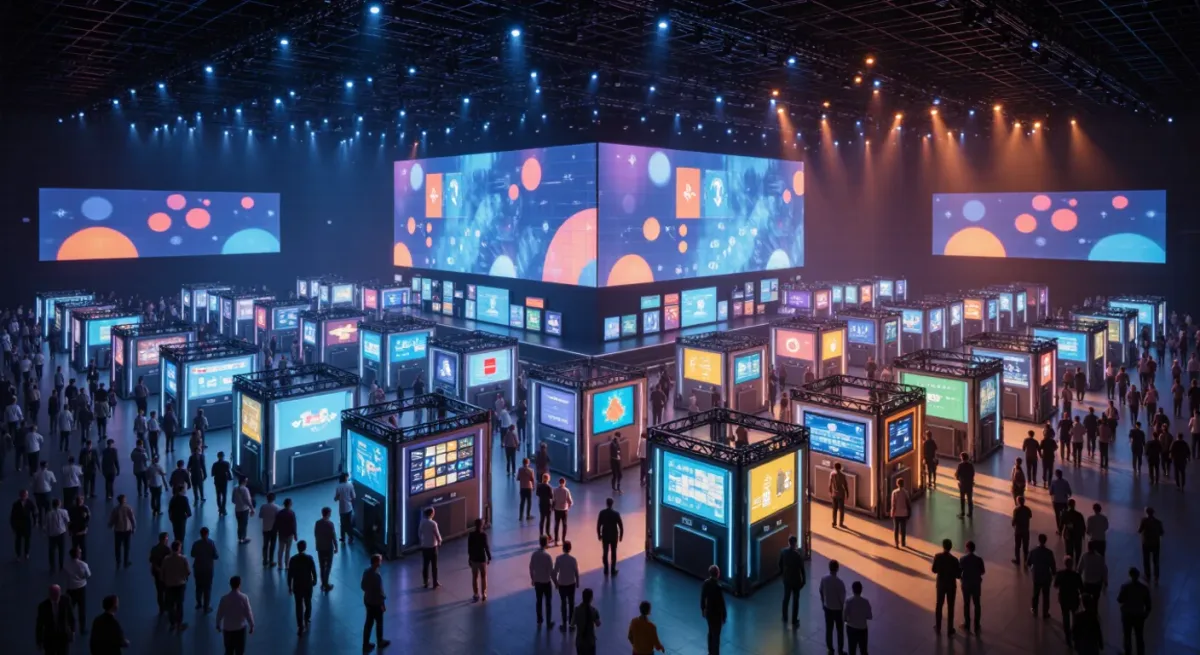
LEAP 2026, the Saudi technology conference rescheduled from its original spring dates after regional disruption, ran August 31 to September 3 at the Riyadh Exhibition and Convention Centre in Malham, closing with nearly $15 billion in announced investments, launches and partnerships, The Arab Weekly reported. The four-day programme drew more than 1,000 speakers across 20 tracks, spanning AI, climate tech, cloud and digital infrastructure.
The total affirms LEAP's position as the Gulf's biggest technology deal venue, a status it has held since its 2022 debut, when its first edition announced multi-billion-dollar commitments that put Riyadh on the global tech-event map. For the region's technology economy, the rescheduled edition's headline matters beyond the sum: the deals landed in the same year Gulf infrastructure absorbed attack damage and airspace closures, a statement of continuity.
What was announced
| Theme | Announcements |
|---|---|
| AI infrastructure | Cloud region and AI Zone commitments, including AWS's $5.3 billion Saudi region reaffirmed for December 2026 and the HUMAIN AI Zone build-out |
| Models and platforms | Saudi Arabic model distribution on global clouds, including ALLaM on Amazon Bedrock; HUMAIN's services placed on cloud marketplaces |
| Digital economy | Startup funds, venture commitments and public-sector digitisation programmes |
| Capacity | Continued investment into Saudi data-centre capacity toward the 1.5-gigawatt 2030 target |
The AWS-HUMAIN sequence
The most concrete corporate thread at the edition was the deepening AWS-HUMAIN partnership: the $5.3 billion Saudi cloud region on track for December 2026, and a commitment to bring up to 50 megawatts of AI compute capacity online in Saudi Arabia's first AI Zone by 2028, roughly a $5 billion initiative. AWS executives reaffirmed the schedule at the event, per statements carried by Amazon's newsroom and trade press.
The background to those commitments, HUMAIN's year from launch to live data centres, is covered in our explainer on Saudi Arabia's national AI company.
Rescheduling as a signal
LEAP's move from spring to late summer, attributed to the regional disruption, cost the event its original calendar slot and raised questions about whether the deal momentum would survive the delay. The answer in the totals: attendance and commitments held, and the next edition, LEAP 2027, is announced for April 12-15, 2027, moving the franchise to a spring slot it evidently intends to keep. Conference economics are confidence instruments; the rescheduled edition performing at scale is a data point about Saudi Arabia's tech-market credibility that the kingdom will use.
LEAP's short history, for context
The conference's rise has been unusually fast. The first LEAP in February 2022 announced commitments in the billions and immediately entered the global tech calendar's top tier; the 2023 edition totalled over $9 billion in announced deals; 2024 and 2025 editions ran in the tens of billions cumulatively as the Saudi AI build-out became the event's spine. The rescheduled 2026 edition's near-$15 billion, arriving in a constrained fiscal year and after months of regional disruption, continues the trajectory with a difference worth noting: a larger share of the announced total came from foreign and private participants than in earlier editions, consistent with the state's stated intent to crowd in capital rather than substitute for it. For an event often read as a barometer of Saudi tech ambition, the composition of the deals now tells as much as their sum.
| Edition | Announced total | Character |
|---|---|---|
| 2022 | Multi-billion at debut | Arrival announcement |
| 2023 | Over $9 billion | Foundation projects |
| 2024-25 | Tens of billions cumulatively | AI build-out era |
| 2026 | Nearly $15 billion | Private and foreign share higher |
The regional competition LEAP feeds
LEAP's totals also serve as the annual scoreboard in the Gulf's technology-city contest. Dubai's agenda runs through enterprise adoption and its established events; Abu Dhabi's through sovereign AI infrastructure and its own summits; Riyadh's through sheer scale, state demand and the conference that aggregates both. Each February-to-spring season now contains a full circuit, and the multipliers, hotels, flights, sponsorship and the talent that follows the calendar, have become a measurable sector in themselves. The rescheduled 2026 edition performing at scale, in the region's most disrupted year, is the strongest evidence yet that the circuit's centre of gravity has genuinely shifted toward Riyadh without displacing its rivals, a multipolar tech map that none of the three cities planned and all three now exploit.
The Riyadh tech scene beyond the hall
The conference is the visible week of a scene that now runs all year. Riyadh hosts the region's densest cluster of venture funding, government digitisation programmes and startup operators, the gaming and esports companies that relocated under the kingdom's entertainment push, and the regional offices of every major cloud and AI vendor. Venue-side, LEAP's deal-making seeds that calendar, pilots announced at the event become procurement rounds, startup showcases become funding rounds, and the halls' real product is a year of follow-on activity. The 2027 spring edition will measure whether the franchise's momentum survives a calendar change, and the smart money, judging by the exhibitor re-bookings announced at closing, says it will.
Context and caution
- Deal totals at LEAP aggregate letters of intent, fund commitments and launch announcements; not all convert to executed investment, and conversion takes years.
- Saudi fiscal restraint through 2026 makes private and foreign capital, visible in this edition's totals, more important to the pipeline than in earlier editions.
- The AI-capacity build-out still faces the power and export-control constraints that govern every Gulf compute project.
The summary: nearly $15 billion announced over four days in Riyadh, anchored by AWS's December cloud-region schedule and a growing sovereign AI complex, at an edition that had every excuse to underperform and did not. The conversion rate from announcement to energised capacity is the number to bring to LEAP 2027.