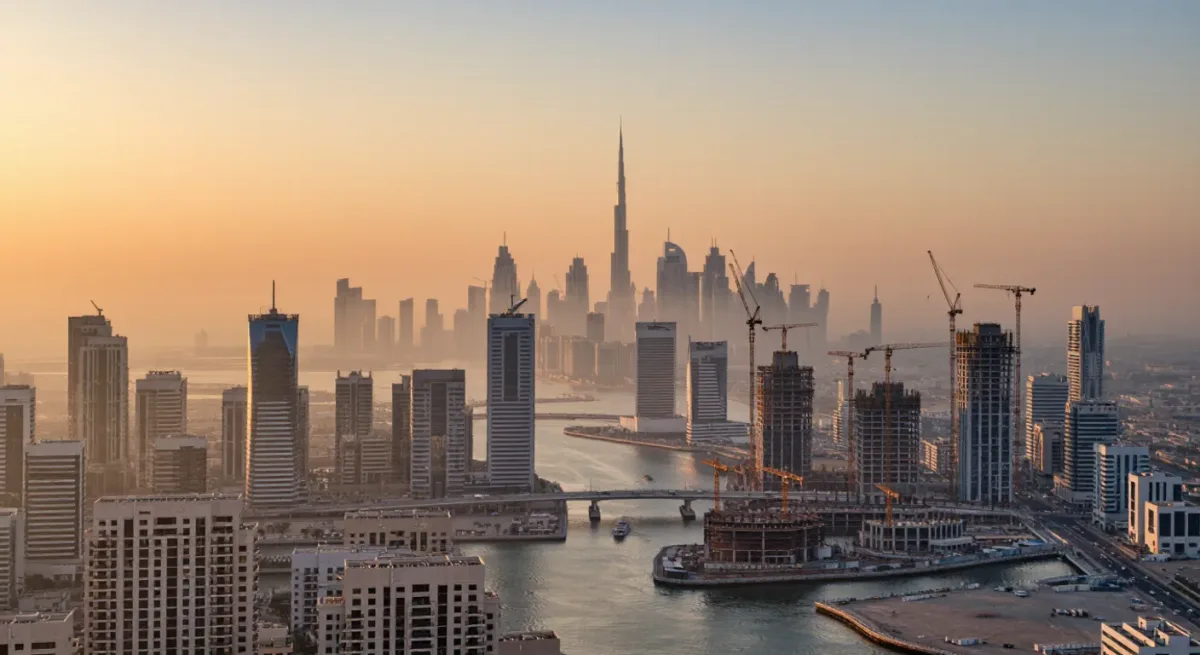
D33 is Dubai's ten-year economic agenda, launched by Sheikh Mohammed bin Rashid Al Maktoum in January 2023, targeting a doubling of the emirate's economy by 2033 through one hundred transformative projects. Its headline quantitative goals: AED 32 trillion in cumulative foreign trade over 2024-2033, and a place among the world's top three economic cities alongside London and New York by the agenda's end date.
The plan succeeded the earlier 2021 and 2020 agendas and is the framework into which Dubai's subsequent policy announcements, the higher education expansion, industrial strategy, and social-media-creator economy initiatives, have been filed. For anyone tracking Dubai's economy, D33 is the reference document behind the press releases.
The targets, numerically
| Goal | Target | Horizon |
|---|---|---|
| Economic size | Double GDP | 2033 |
| Foreign trade | AED 32 trillion cumulative | 2024-2033 |
| City ranking | Top three global economic cities | 2033 |
| Foreign direct investment | Annual average AED 60 billion | 2024-2033 |
| Government projects partly foreign-financed | Increase private participation | Ongoing |
The mechanisms
D33's projects cluster in five programmes: raising productivity through technology adoption, accelerating trade through corridors and the CEPA network of trade agreements the UAE has negotiated since 2021, growing the digital economy, building new sectoral pillars from semiconductors to health, and attracting talent and capital through visa and business-environment reform. The agenda also created the Dubai Economic Agenda implementation office and tied department KPIs to its milestones.
Two earlier reforms do much of the load-bearing: the 2021 shift to full foreign ownership of mainland companies and the long-stay visa regime, which together expanded the resident investor base D33 counts on. The agenda's function is partly narrative, aligning private-sector confidence with a stated direction, and Dubai has historically priced that alignment highly.
Progress against the numbers
Dubai's economy has outperformed the agenda's baseline since launch. Official statistics showed growth continuing through 2024 and 2025, with the emirate's GDP crossing AED 937 billion in 2025 on growth of 5.4 percent, and annual foreign trade records accompanying it, the milestones tracked in our coverage of Dubai's 2025 GDP figures. Population growth, a live proxy for the agenda's talent goals, has run at the fastest sustained rate in the emirate's modern history.
Against that, the doubling target implies average real growth near 7 percent a year, above what most forecasters project for the decade's second half, and the top-three-city goal is a ranking that depends on rivals' performance as much as Dubai's. The agenda's honest readers treat the 2033 numbers as direction-setting rather than promise-keeping.
How it compares with Vision 2030
Saudi Arabia's Vision 2030 is a state-led transformation with giga-projects and society-wide reform; D33 is a city-state competitiveness programme, narrower, cheaper and faster-moving, aiming to compound Dubai's existing advantages in trade, logistics and services. The two agendas intersect in rivalry for corporate headquarters and in cooperation through the trade lanes between the UAE and Saudi Arabia.
For the trade-agreement pillar that feeds D33's AED 32 trillion target, see our explainer on the UAE's CEPA network.
The projects, in categories
The agenda's hundred projects sort into five working categories, and knowing them cuts through the announcements. Trade projects: corridors, digital trade infrastructure and the CEPA network that feeds the AED 32 trillion target. Productivity projects: technology adoption programmes, industrial automation support and the digital-economy targets. New-sector projects: semiconductors, advanced manufacturing, health and the creator-economy initiatives that emirate agencies have launched since 2023. Business-environment projects: licensing reform, the judicial and dispute-resolution upgrades, and talent-visa expansions. And capital projects: the funds and co-investment vehicles designed to pull foreign direct investment toward the AED 60 billion annual average. Each quarter's policy releases file neatly into these boxes, which is how the agenda stays a strategy rather than a scrapbook.
| Category | Flagship logic |
|---|---|
| Trade | Corridors and agreements toward AED 32tn cumulative |
| Productivity | Technology adoption across enterprises |
| New sectors | Semiconductors to creator economy |
| Business environment | Licensing, courts, visas |
| Capital | FDI vehicles toward AED 60bn a year |
How the agenda is governed
For businesses, the operational reading is simpler than the document: D33 tells you which doors Dubai will keep unlocked, trade corridors, licensing speed, visas, capital repatriation, and the agenda's mid-term report card suggests the emirate has kept them so.
The agenda's fifth birthday falls in 2028, past the halfway mark, and the emirate's habit is to refresh such programmes with successor documents rather than let them age, so watchers should expect a D33 successor conversation in the late 2020s calibrated to whatever doubling turns out to mean by then.
D33 is governed the way Dubai governs large programmes: a central implementation track anchored in the ruler's court, departmental KPIs aligned to the milestones, and public reporting through the emirate's statistics and media channels. The model's strength is execution speed, demonstrated across the agenda's early years as licensing, visa and sector programmes landed on schedule; its limitation is measurement independence, since the entity reporting progress owns the targets. Outsiders pricing Dubai's commitments hedge accordingly, tracking the third-party series, GDP releases, trade data, population counts, rather than the agenda's own scorecard, and those series through 2025 have trended the agenda's way, which is the most an outside auditor can ask of a self-graded paper.
Why it matters to outsiders
D33 tells investors what Dubai will protect: openness, speed of licensing, connectivity and tax competitiveness. Every escalator in the emirate's recent policy, from the corporate tax carve-outs for qualifying free zone business to the talent visas, aligns with the agenda's logic. For a city whose product is its business environment, the agenda is the product roadmap, and its milestones are the due-diligence checklist.